Most common
Plaque psoriasis
Well-defined raised plaques with silvery scale, classically on elbows, knees, the lower back and the scalp.
- Around 80–90% of cases
- Symmetrical
- Responds to topicals and light

Psoriasis is not a skin infection, not contagious, and not curable. It is an immune condition that flares and settles, and the aim of good treatment is a longer gap between flares, not a photograph of clear skin taken once.
In normal skin, a cell takes around four weeks to travel from the base of the epidermis to the surface and shed. In psoriasis that journey takes a few days. The cells pile up before they mature, and the result is the thickened, silvery-scaled plaque that gives the disease its appearance.
The acceleration is driven by the immune system: specific inflammatory signals, which is precisely why the newer treatments that block those signals work so well. It is not an infection, it is not caused by poor hygiene, and it cannot be caught from anyone.
It is also more than a skin disease. Psoriasis carries a meaningful association with joint disease, with metabolic syndrome, and with cardiovascular risk. A consultation that only looks at the plaques is an incomplete consultation.

Dr. (Lt Col) Khagendra Varada
Reg. No. 10461, Hyderabad State Medical Council
Full background →“I have been going pillar to post to get my son cured of his white spot on his left side of lip and chin. It appeared 8 years back. I was told it’s special type of nerve vitiligo which has no cure. After reporting to him he told us that it is SEGMENTAL VITILIGO and unlikely and difficult to be cleared by medications alone. He suggested for surgical melanocyte transplant… I was amazed after around one month that he started rapidly getting pigmentation. I wholeheartedly suggest please do not waste time like I did.”
“Dr. Varada is an incredibly patient, knowledgeable and wonderful doctor. He sorted out an issue that I had been dealing with for years in one appointment and there’s been no looking back since!”
Side by side, the difference is structural rather than cosmetic: the epidermis thickens, drives deep ridges down into the layer beneath, and sheds immature cells as scale, while blood vessels crowd up close to the surface. That last detail is why a scratched plaque bleeds in pinpoints.
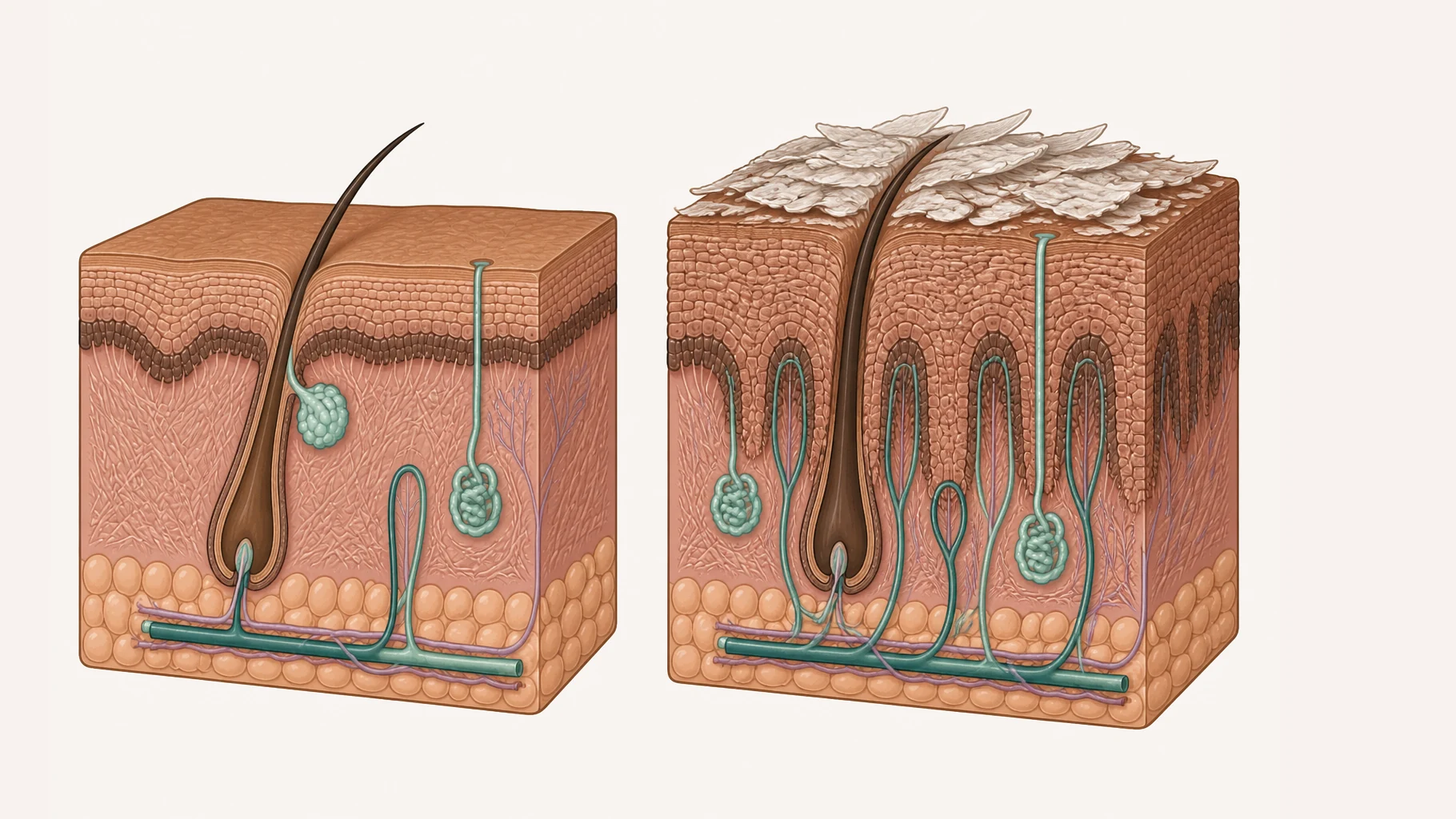
Nothing here is caused by hygiene and none of it is catching. The acceleration is driven by immune signalling, which is exactly what the newer treatments block.
Illustration, not a photograph.
Up to a third of people with psoriasis develop psoriatic arthritis, and the joint damage it causes does not reverse. Morning stiffness lasting over 30 minutes, a swollen finger or toe, heel pain, or low back pain that improves with movement all need reporting. Early treatment protects the joint.
Psoriasis carries recognised associations with joint disease, with metabolic syndrome and fatty liver, and with cardiovascular risk. They are associations rather than certainties, but they are common enough that not asking about them is a gap in care.

This is why blood pressure, sugar, lipids and a question about joints belong in a psoriasis review. A consultation that only looks at the plaques is an incomplete consultation.
Illustration, not a photograph.
Well-defined raised plaques with silvery scale, classically on elbows, knees, the lower back and the scalp.
Sudden crops of small drop-like spots across the trunk, frequently two to three weeks after a throat infection.
Smooth red areas in body folds without obvious scale; pitting, thickening or lifting of the nails.
Treatment is chosen by how much skin is involved and how much the disease is affecting your life. Not by how it looks in a photograph.
| Treatment | What it does | Typically for |
|---|---|---|
| Emollients | Reduces scale, cracking and itch | Everyone, always, alongside |
| Topical steroids | Suppresses local inflammation | Limited plaque disease |
| Vitamin D analogues | Slows the cell turnover | Maintenance; steroid-sparing |
| Coal tar / salicylic acid | Descaling; long-established | Scalp and thick plaques |
| NB-UVB phototherapy | Damps the immune response in skin | Widespread disease; guttate |
| Methotrexate | Systemic immune suppression | Extensive or resistant disease |
| Other systemics | Ciclosporin, acitretin, apremilast | Where methotrexate is unsuitable |
| Biologics | Blocks a specific inflammatory signal | Severe disease; failed systemics |
Nothing on this list cures psoriasis. Each moves the disease toward remission and holds it there, and most patients change rungs over their lifetime.
Almost any potent treatment will clear a plaque. Steroids clear plaques. The question that separates good psoriasis care from bad is what happens in month four, whether the disease is quietly rebounding because a strong topical was used for too long without a maintenance plan.
So treatment here is written as a sequence: what clears the flare, what holds it, when to step down, and what to do at the first sign of the next one. Patients who have that written down flare less.
What triggers a flareAbruptly stopping a potent steroid is one of the commonest causes of a rebound flare, sometimes worse than the original.
What to start, at what point, and when to call. It turns a three-week flare into a three-day one.
Plaques cleared with creams and light, photographed in the same position before and after, and published with written consent. The darker marks left behind fade more slowly than the plaques did; the captions say so. Results differ from person to person.
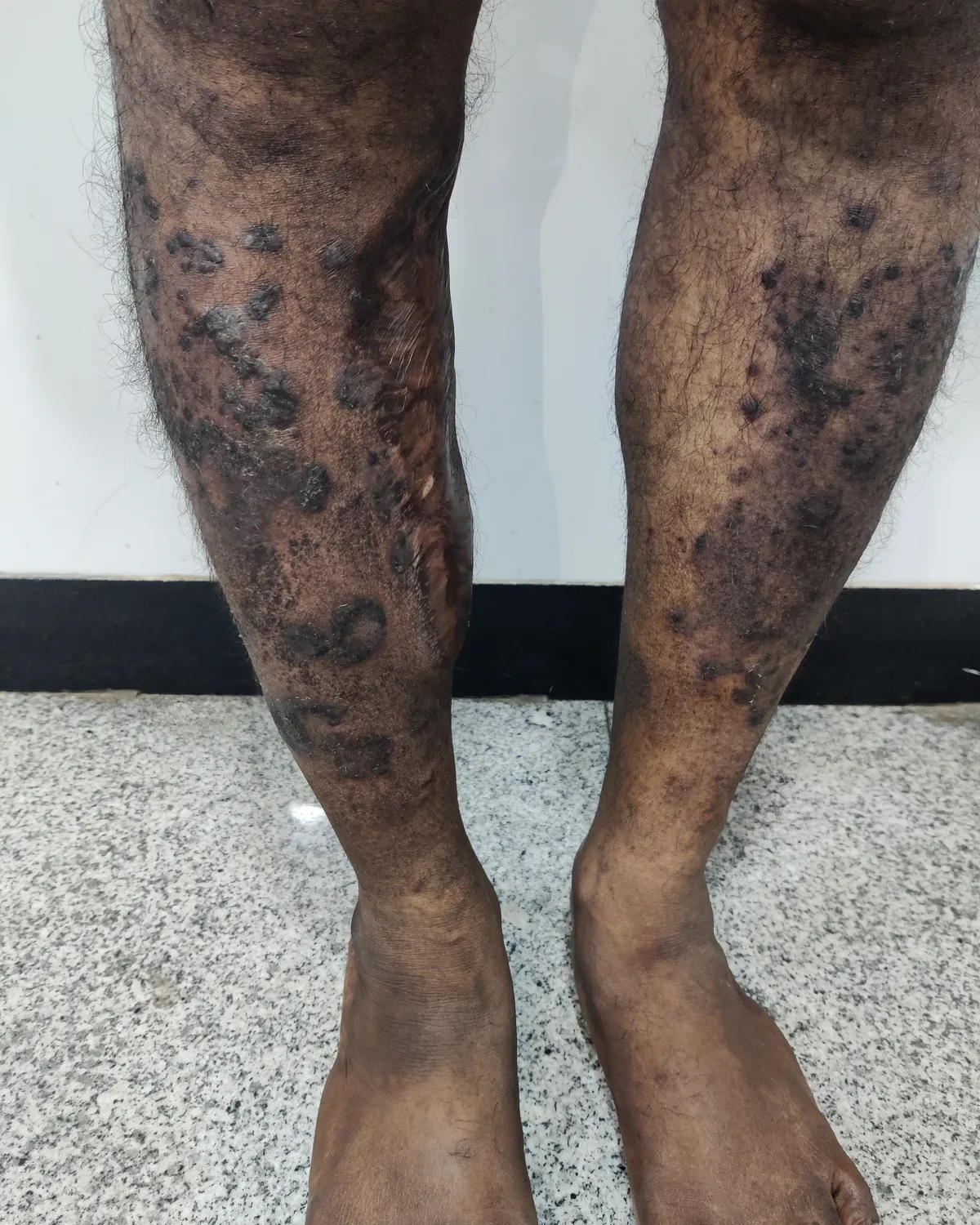

The raised, scaly plaques cleared. The darker marks left behind are not the disease coming back — colour fades more slowly than the plaque does, and it does fade.
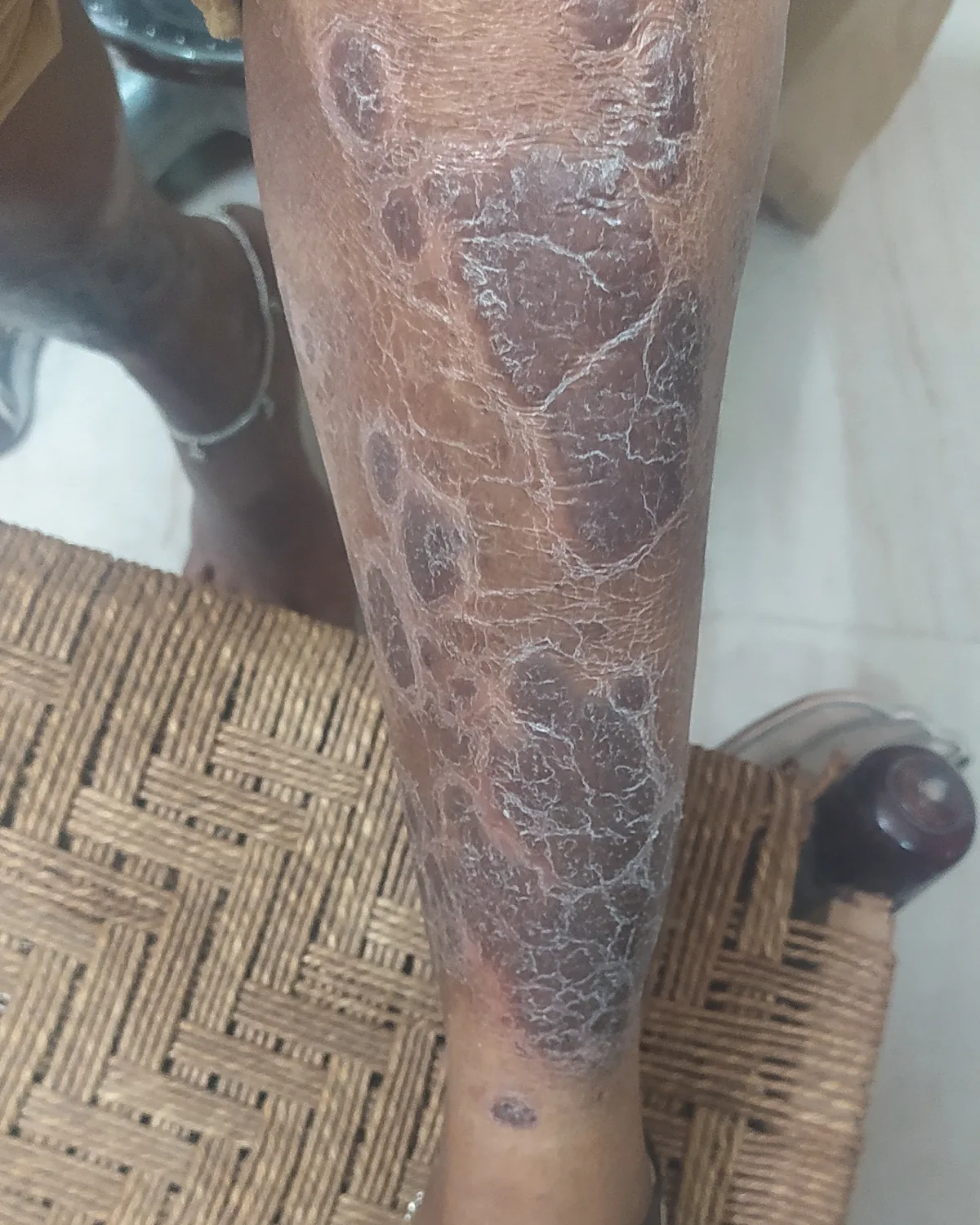
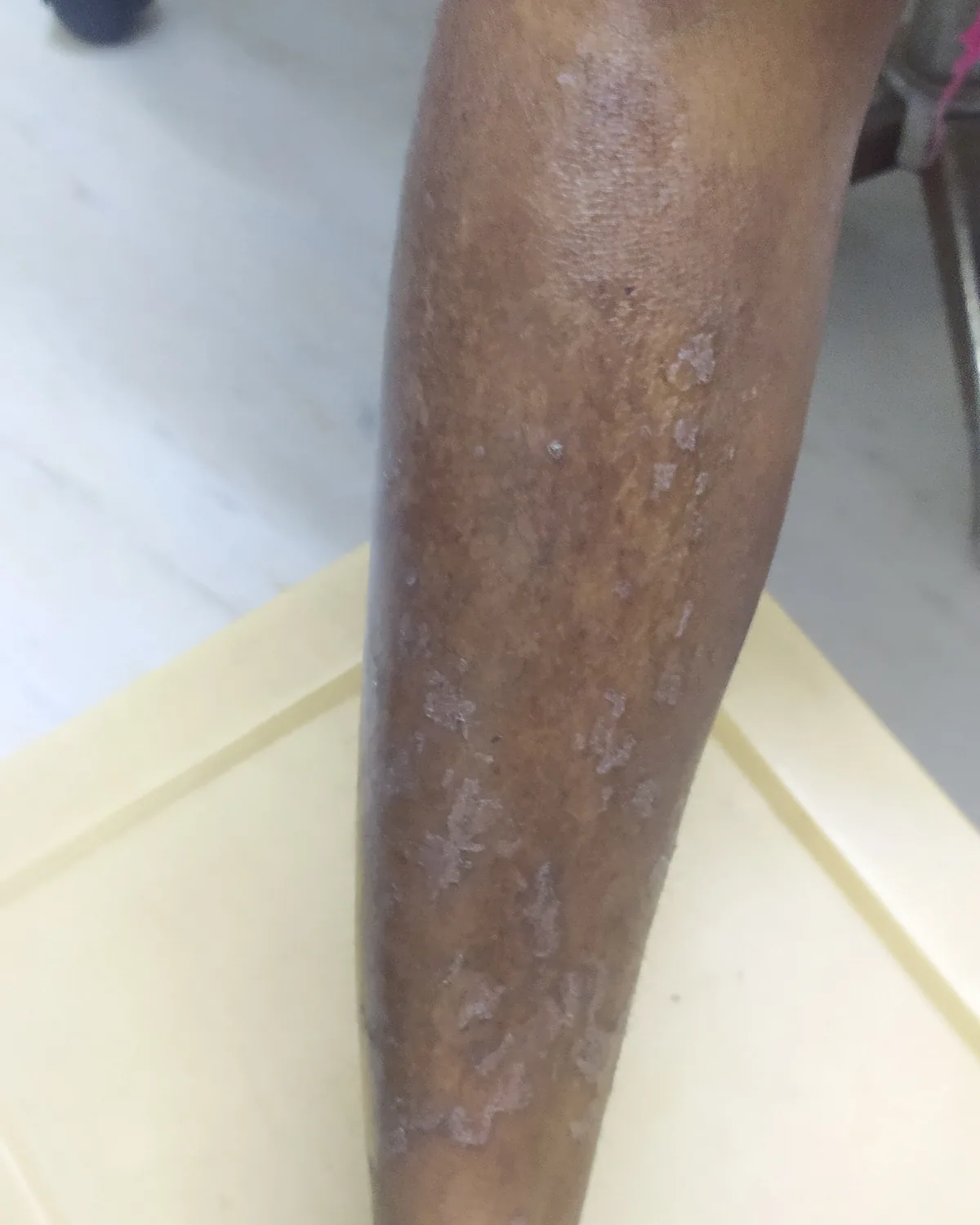
A thick, cracked plaque covering most of one shin. The scale settles first and the colour underneath takes longer to even out.
No. Psoriasis is a long-term immune condition, and no treatment available cures it. Any clinic offering a permanent cure is making a claim it cannot support.
What treatment does achieve, often very well, is remission: skin that is clear or nearly clear, held there with maintenance, sometimes for years at a time.
No. It cannot be caught by touch, by sharing a towel or a swimming pool, or by any other contact. It is an immune condition, not an infection.
The commonest are throat infections, stress, stopping a treatment abruptly, skin injury, certain medications including some blood pressure and antimalarial drugs, smoking and heavy alcohol use. Cold dry weather worsens many people’s disease.
There is no psoriasis diet that clears the disease. What does have evidence is that losing excess weight improves both the psoriasis and how well treatment works, and that heavy alcohol use makes disease worse and limits drug choices.
Not necessarily continuous treatment, but lifelong awareness. Many patients cycle between active treatment during flares and maintenance or nothing in between. The aim is longer gaps, not a permanent prescription.
Yes. Psoriatic arthritis affects up to a third of patients. There are also recognised associations with metabolic syndrome, fatty liver and cardiovascular risk, which is why blood pressure, sugar and lipids are checked.
No, although they are constantly confused. Scalp psoriasis has thicker, adherent silvery scale, often extends past the hairline, and does not respond to ordinary anti-dandruff shampoo alone.
The clinical statements on this page follow the guidance and evidence below. They are independent sources. None of them is connected to this clinic, and none of them sells the treatments described here.
Not a treatment plan sold on the spot. Message the clinic and bring your history.