
Scalp psoriasis
The scalp is the commonest site of psoriasis and the one most often treated wrongly, because thick adherent scale blocks every medicine applied on top of it. The order of treatment matters more than the choice of it.
At a glance
- How common
- Affects around half of psoriasis patients
- Key sign
- Scale extending past the hairline
- Confused with
- Dandruff, seborrhoeic dermatitis
- First step
- Descale: nothing works through scale
- Hair loss
- Usually temporary, from scratching and picking
- Review
- 6–8 weeks
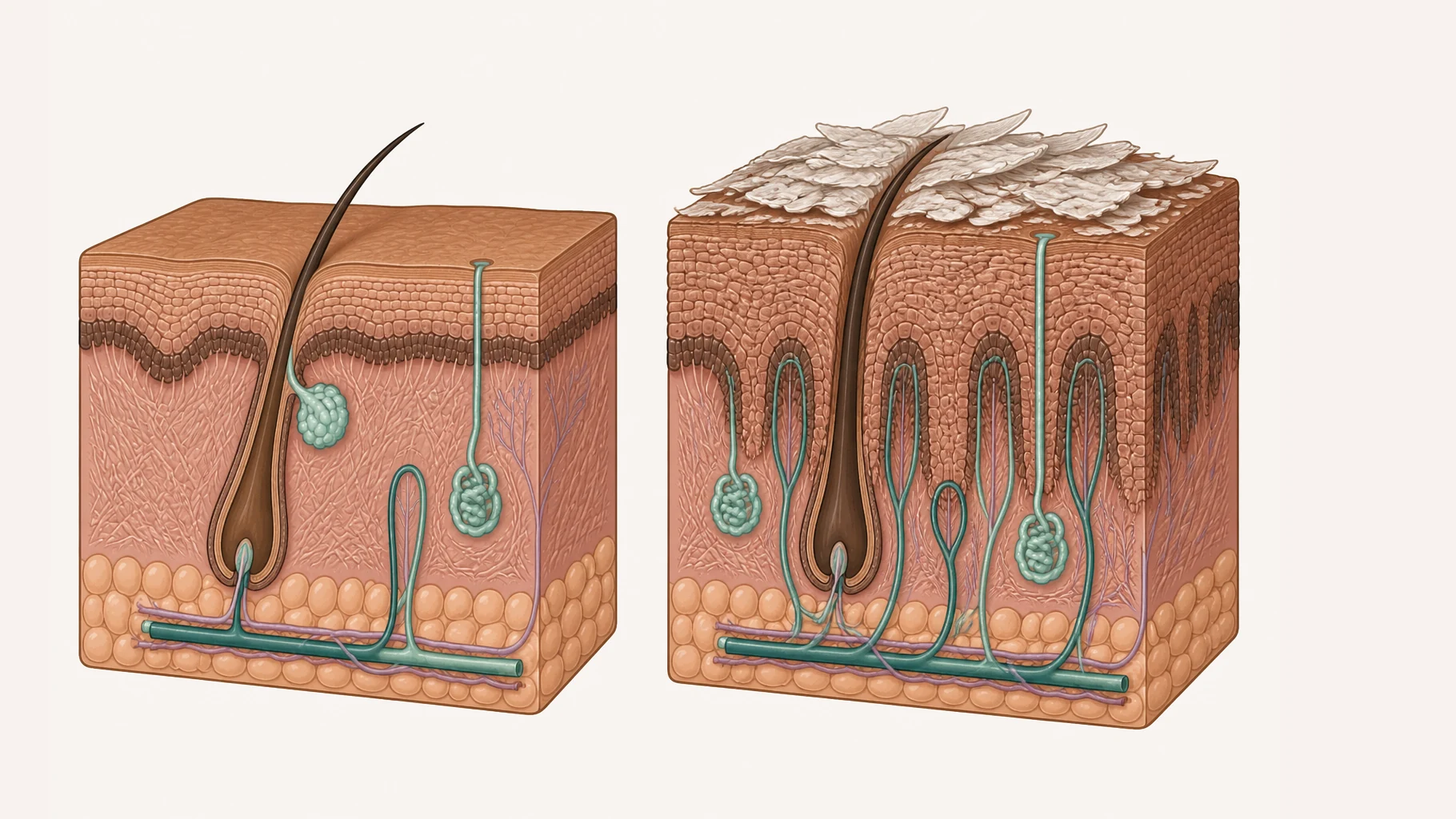
Two different things on the same scalp.
They flake in the same place and are treated completely differently. Psoriasis thickens the epidermis and drives deep ridges into the layer beneath, shedding dry silvery scale. Seborrhoeic dermatitis is an oil-and-yeast problem, and its scale is greasy and yellower.
- 1
- 2
- 3
- 4
- 5
- 1Scale
- 2Normal skin
- 3Thickened epidermis
- 4Deep ridges
- 5Crowded vessels
The distinction decides the treatment: a descaling and anti-inflammatory routine for one, an antifungal shampoo held in the routine for the other. Getting it wrong is the commonest reason a scalp does not settle.
- Scale
- Normal skin
- Thickened epidermis
- Deep ridges
- Crowded vessels
Illustration, not a photograph.
Who is treating you, and what his patients said.

Dr. (Lt Col) Khagendra Varada
- 45 years in dermatology and dermatosurgery
- 25 of them in the Indian Army Medical Corps
- MBBS, Osmania Medical College
- Dip. Practical Dermatology, Cardiff · Dip. Dermatology, AAAM
Reg. No. 10461, Hyderabad State Medical Council
Full background →“I have been going pillar to post to get my son cured of his white spot on his left side of lip and chin. It appeared 8 years back. I was told it’s special type of nerve vitiligo which has no cure. After reporting to him he told us that it is SEGMENTAL VITILIGO and unlikely and difficult to be cleared by medications alone. He suggested for surgical melanocyte transplant… I was amazed after around one month that he started rapidly getting pigmentation. I wholeheartedly suggest please do not waste time like I did.”
“Dr. Varada is an incredibly patient, knowledgeable and wonderful doctor. He sorted out an issue that I had been dealing with for years in one appointment and there’s been no looking back since!”
Scalp psoriasis or dandruff?
These are treated differently, and the distinction is usually visible without any test at all.
| Scalp psoriasis | Dandruff / seborrhoeic dermatitis | |
|---|---|---|
| Scale | Thick, silvery, adherent | Fine, white or greasy, loose |
| Border | Sharply defined patches | Diffuse, ill-defined |
| Hairline | Extends onto forehead, behind ears, nape | Usually stops at hairline |
| Feel | Raised, lumpy to the fingertips | Flat |
| Elsewhere | Often plaques on elbows, knees; nail pitting | Face, eyebrows, chest |
| Response to anti-dandruff shampoo | Partial at best | Usually good |
The two can coexist. ‘Sebopsoriasis’ is a genuine overlap. Where it is unclear, the elbows, knees and nails usually settle it.
What dandruff actually is.
For comparison: in seborrhoeic dermatitis the sebaceous glands are over-active, a yeast that lives on every scalp feeds on the oil, and the scalp reacts to that. The flaking is the reaction rather than the cause.

- 1Greasy scale
- 2Yeast living in the oil
- 3Inflammation underneath
- 4Oil gland, working overtime
Nothing here removes the glands or the yeast, which is why medicated shampoo stays in the routine after the scalp clears rather than stopping with the symptoms.
- Greasy scale
- Yeast living in the oil
- Inflammation underneath
- Oil gland, working overtime
Illustration, not a photograph.
Descale first, then treat
Soften the scale
A salicylic acid or oil-based preparation applied to the scalp and left on, often overnight, to lift adherent scale. This step is skipped constantly and is why treatments ‘don’t work’.
Wash it out properly
A tar or ketoconazole shampoo, worked into the scalp rather than the hair, and left for several minutes before rinsing.
Now apply the active treatment
A steroid or vitamin D scalp application, which can finally reach skin instead of sitting on scale.
Step down to maintenance
Reduce frequency once controlled rather than stopping. Abrupt stopping is the commonest cause of a rebound.
Does scalp psoriasis cause hair loss?
Usually yes, temporarily, and usually not because of the psoriasis itself. Hair is lost from scratching, from picking scale off (which pulls hairs with it), and from the inflammation of a severe flare. It regrows once the scalp settles.
Permanent loss is uncommon and results from prolonged severe inflammation or repeated trauma to the same area. The practical message is not to pick the scale. Soften it and let it come away.
If hair loss persistsDon’t pick, soften
Scale removed by force takes hair with it. Oil, soften, and let it lift.
Regrowth follows control
Hair generally returns within months once the scalp is quiet. If it does not, it is assessed separately.
What makes scalp treatment actually work.
- Treat the scalp, not the hair: part it and apply to skin
- Give it contact time: minutes, not a rinse
- Overnight oil before wash days during a flare
- Don’t stop abruptly: step down the frequency
- Behind the ears and nape are missed constantly
- Colouring hair is fine when the scalp is calm, not during a flare
Joint pain with psoriasis is not a coincidence
Up to a third of people with psoriasis develop psoriatic arthritis, and the joint damage it causes does not reverse. Morning stiffness lasting over 30 minutes, a swollen finger or toe, heel pain, or low back pain that improves with movement all need reporting. Early treatment protects the joint.
Scalp psoriasis
How do I know if it’s psoriasis or dandruff?
Psoriasis scale is thicker, silvery and stuck down, forms sharply bordered patches, and typically extends past the hairline onto the forehead, behind the ears or down the nape. Dandruff is finer, looser and stops at the hairline.
Why doesn’t anti-dandruff shampoo work on it?
Partly because the active ingredient cannot penetrate thick adherent scale, and partly because psoriasis is a different disease. Descaling first is what makes subsequent treatment effective.
Will my hair grow back?
In almost all cases, yes. Hair loss in scalp psoriasis is usually from scratching and picking rather than the disease destroying follicles, and it regrows once the scalp is controlled.
Can I colour or chemically treat my hair?
When the scalp is calm, generally yes. During an active flare, colouring and chemical straightening will sting on cracked skin and can aggravate it. Wait until it settles.
Is scalp psoriasis a sign of worse disease elsewhere?
Not necessarily, but it is worth a full skin and nail examination. Nail pitting in particular matters, because nail involvement is associated with psoriatic arthritis.
The clinical statements on this page follow the guidance and evidence below. They are independent sources. None of them is connected to this clinic, and none of them sells the treatments described here.
- Scalp psoriasisDermNet (New Zealand Dermatological Society)
- Psoriasis resource centreAmerican Academy of Dermatology
- Psoriasis: assessment and management (CG153)National Institute for Health and Care Excellence (UK)
- Seborrhoeic dermatitisDermNet (New Zealand Dermatological Society)
Related on this site
The first appointment is a diagnosis.
Not a treatment plan sold on the spot. Message the clinic and bring your history.