Where
Plot No 13D/B, Wellington Rd, Vikrampuri Colony, Karkhana, Secunderabad, Telangana 500009.
- Serves Trimulgherry, West Marredpally, Bowenpally, Alwal
- Formerly BNR Skin & Vitiligo Hospital

A peel is a controlled chemical injury that makes skin renew itself. On Indian skin the depth and the aftercare matter more than the ingredient, because the same treatment that clears pigmentation can cause it.
Skin that produces pigment readily responds to injury by producing more pigment. A peel is a deliberate, controlled injury. Done at the right depth with the right aftercare it clears pigmentation; done too deep or without sun protection afterwards it produces exactly the pigmentation it was meant to treat.
This is why peeling protocols for darker skin are conservative: superficial to medium depth, built up gradually across a course, with priming beforehand and rigorous sun protection throughout. It is slower than the aggressive single-session approach, and it is the reason it works.
Melasma deserves a specific warning. It is the commonest reason people ask about peels, it is genuinely improvable, and it is also prone to rebounding worse if treated aggressively. It is managed as a long-term condition rather than removed.

Dr. (Lt Col) Khagendra Varada
Reg. No. 10461, Hyderabad State Medical Council
Full background →“I was pleasantly surprised when my melasma cleared with four sessions of strong salicylic Acid peels. I believe BNR skin formulates salicylic acid and TCA Peels in house… Therefore they are very effective, only downside is that they sting a lot.”
“I like Dr Khagendra’s knowledge. If I dont understand something, he explains patiently. I am seeing the results of his treatment. The skin is starting to repigment very fast.”
Every peel removes a controlled thickness of skin and lets it heal back. How deep it reaches decides what it can treat, how long recovery takes, and how much risk it carries — particularly on brown skin.
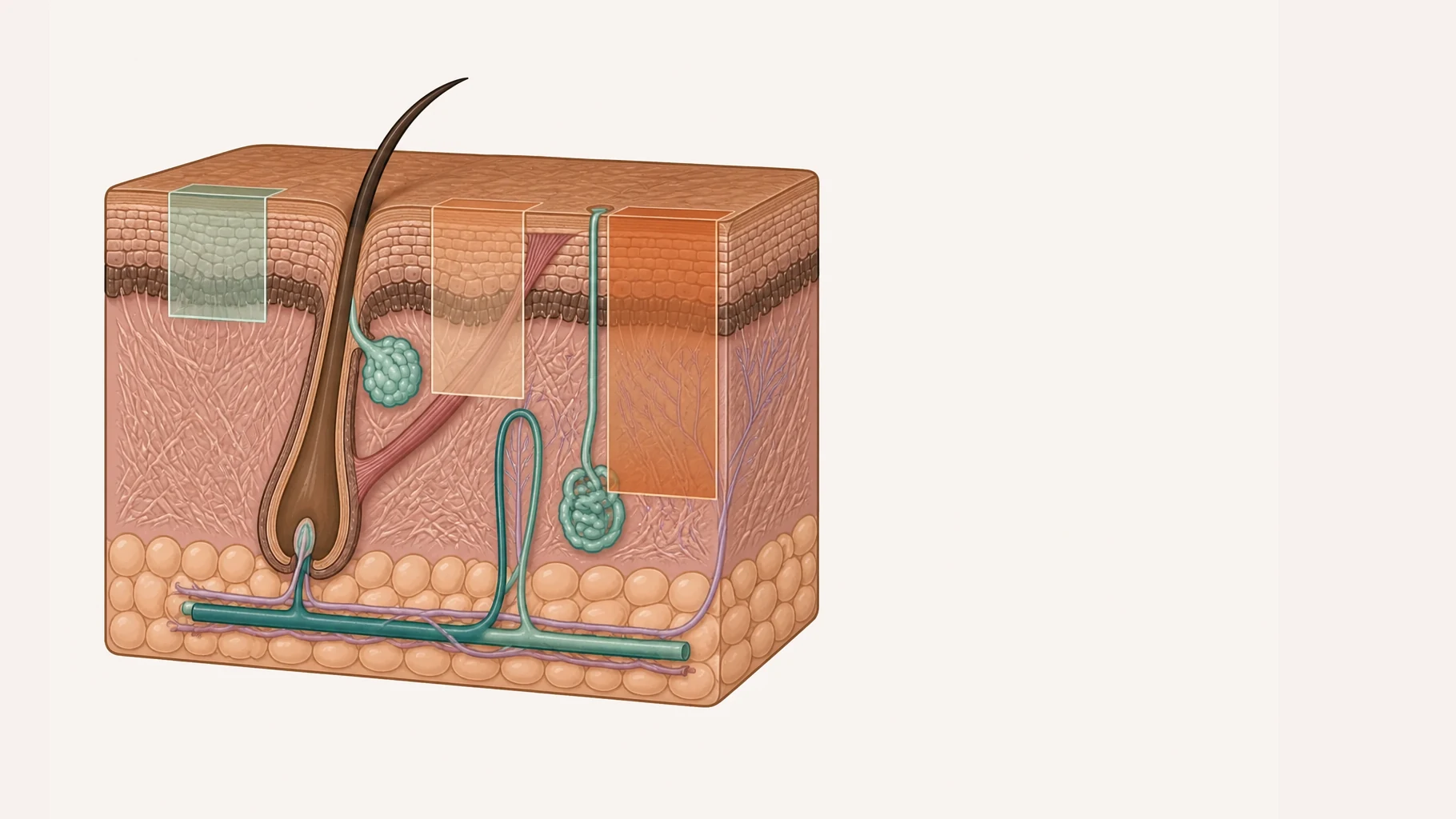
Deeper is not better. Most of what a peel is used for here is achieved in the top two layers, and the complications almost all come from going deeper than the problem required.
Illustration, not a photograph.
| Concern | Realistic outcome | Notes |
|---|---|---|
| Post-acne brown marks | Good: often substantial improvement | Often the most satisfying indication |
| Melasma | Improvement, needs maintenance | Prone to rebound; treated conservatively |
| Dull, uneven tone | Good | Usually a short course |
| Rough texture, open pores | Modest | Combined approaches work better |
| Fine lines | Modest | Not a substitute for other modalities |
| Active acne | Adjunct only | Control the acne medically first |
| True indented scars | Not the right treatment | Needs procedural scar work |
The last two rows are where peels are most often mis-sold. Peels support acne treatment; they do not replace it, and they do not fill a scar.
Topical preparation for some weeks before the first peel reduces pigmentary complications considerably. It is not an upsell. It is risk reduction.
Depth is built across sessions based on how your skin responded to the last one, rather than fixed in advance.
Two to four weeks apart. Skin needs to complete its recovery before the next injury is applied.
Daily broad-spectrum sunscreen throughout the course and after it. This is the step that decides the outcome.
Peeling and flaking for a few days is expected, picking at it is not. Skin lifted before it is ready leaves marks that last far longer than the peel would have.
The other frequent failure is sun. A week of good aftercare followed by a sunny afternoon undoes the session and can leave the treated area darker than when it started.
If the acne is still activeLet flaking lift on its own. Forcing it is the commonest cause of post-peel marks.
Not just on the day. Throughout the course and for weeks after it.
Consulting rooms, phototherapy and the surgical list at one address in Secunderabad. The practice was formerly known as BNR Skin & Vitiligo Hospital.
Plot No 13D/B, Wellington Rd, Vikrampuri Colony, Karkhana, Secunderabad, Telangana 500009.
On WhatsApp: one number, answered by the clinic team, who confirm a time and say what to bring.
Usually a course spaced two to four weeks apart. The number depends on the concern. Post-acne pigmentation often responds within a few sessions, melasma needs ongoing management.
Yes, when the depth is conservative, the skin is primed beforehand and sun protection is rigorous. The risk in darker skin is post-inflammatory pigmentation, which is exactly what a cautious protocol is designed to avoid.
Priced per session and quoted after assessment, because the peel chosen and the number of sessions depend on your skin and your concern. A single session price without a course plan is not a useful comparison.
Superficial peels usually cause mild flaking for a few days rather than dramatic shedding. Deeper peels peel more. Do not pick at it. That is the commonest cause of marks afterwards.
They improve the brown marks left by acne, which many people take for scars. True indented scars need procedural treatment; peels will not fill them.
It depends on the treatment. Some, particularly oral retinoids, require a gap before peeling. Tell the clinic everything you are using.
The clinical statements on this page follow the guidance and evidence below. They are independent sources. None of them is connected to this clinic, and none of them sells the treatments described here.
Not a treatment plan sold on the spot. Message the clinic and bring your history.