
Narrowband UVB phototherapy
The most widely used vitiligo treatment in the world, and the one with the most evidence behind it. It works by waking up the pigment cells still living in your hair follicles, which is also the reason it works on some sites and not others.
At a glance
- What it is
- 311 nm ultraviolet B, whole-body or targeted
- Frequency
- 2–3 sessions a week
- First verdict
- 3 months, not 3 weeks
- Full course
- Often 6–12 months
- Responds best
- Face, neck, trunk
- Responds least
- Hands, feet, lips
Light that recruits the cells you still have.
Narrowband UVB is ultraviolet light at a very specific wavelength. Around 311 nanometres. At that wavelength it does two useful things at once: it damps down the local immune attack that is destroying pigment cells, and it stimulates the melanocytes that survive in hair follicles to multiply and migrate up into the skin surface.
That second mechanism explains the pattern of results. Repigmentation typically appears first as small dark dots scattered inside the patch, each one centred on a hair. Those dots enlarge and merge. It is slow, and it looks odd halfway through, and it is exactly what success looks like.
It also explains the failures. Skin with few hair follicles (fingertips, the backs of the hands, lips), has little to recruit from. And a patch whose hairs have themselves gone white has lost its reservoir. Those are the patches that need surgery rather than more light.
Who is treating you, and what his patients said.

Dr. (Lt Col) Khagendra Varada
- 45 years in dermatology and dermatosurgery
- 25 of them in the Indian Army Medical Corps
- MBBS, Osmania Medical College
- Dip. Practical Dermatology, Cardiff · Dip. Dermatology, AAAM
Reg. No. 10461, Hyderabad State Medical Council
Full background →“I have been going pillar to post to get my son cured of his white spot on his left side of lip and chin. It appeared 8 years back. I was told it’s special type of nerve vitiligo which has no cure. After reporting to him he told us that it is SEGMENTAL VITILIGO and unlikely and difficult to be cleared by medications alone. He suggested for surgical melanocyte transplant… I was amazed after around one month that he started rapidly getting pigmentation. I wholeheartedly suggest please do not waste time like I did.”
“Dark spots are seen in one month… Even before perticular treatment for vitiligo, great”
Light that reaches exactly far enough.
Narrowband ultraviolet penetrates the epidermis and the top of the dermis and stops there. In that zone it does two useful things at once: it calms the immune cells attacking pigment, and it stimulates the pigment cells that survive.
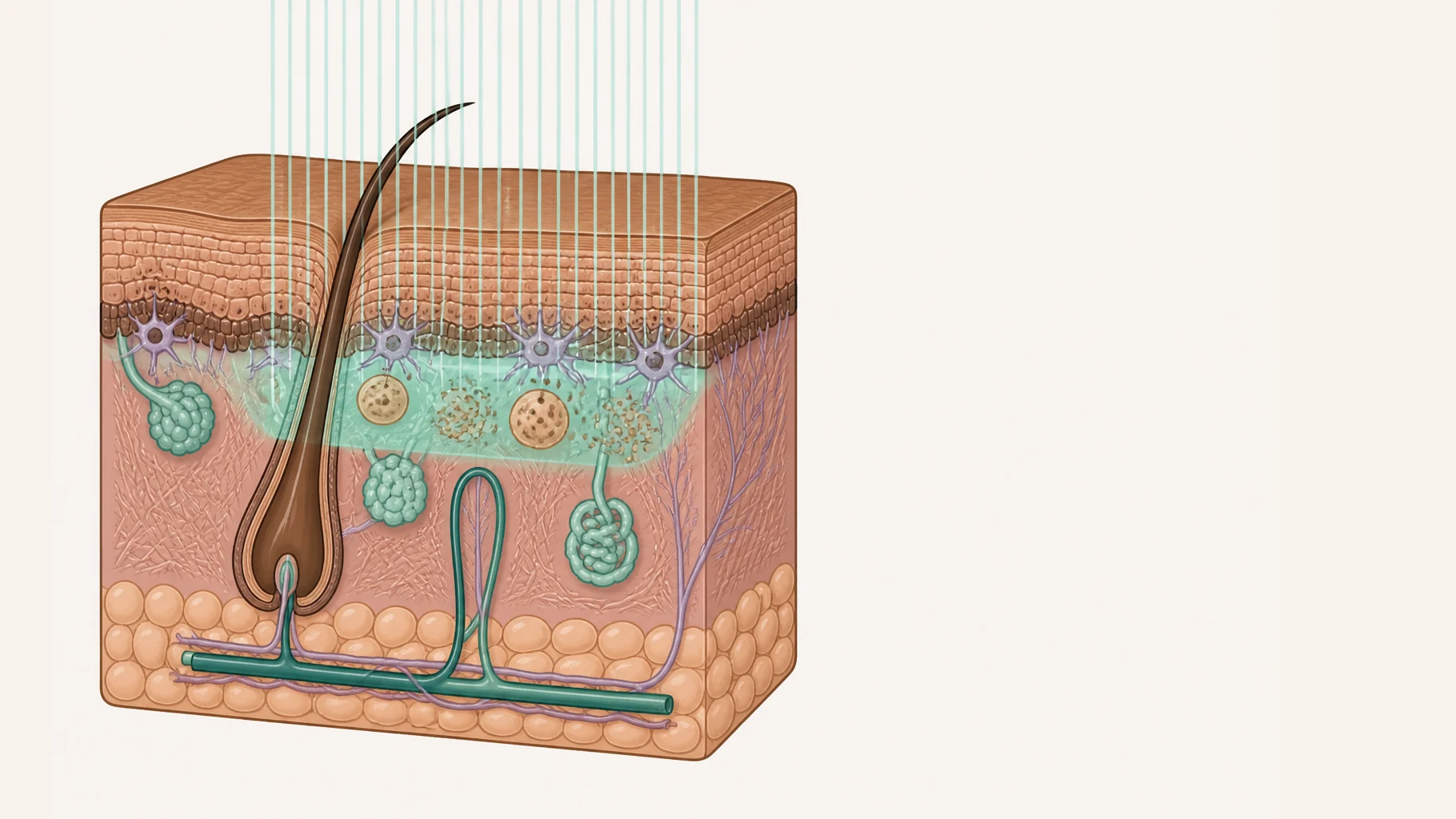
- 1Ultraviolet enters here
- 2Pigment cells reactivated
- 3Immune cells suppressed, and no deeper
It is not sunbathing and it is not a tanning bed. The wavelength is narrow, the dose is measured, and the depth it reaches is why it is safe to repeat.
- Ultraviolet enters here
- Pigment cells reactivated
- Immune cells suppressed, and no deeper
Illustration, not a photograph.
What the schedule looks like
Start low, build up
The first dose is deliberately conservative and increased session by session until the skin shows a faint pinkness that fades within a day. That threshold is individual.
Two or three times a week
Consistency matters more than intensity. Two sessions a week for six months beats five sessions a week for three.
First honest review at three months
Perifollicular dots by month three is a good sign. Nothing at all by month four on responsive sites means the plan changes.
Taper, don’t stop
Frequency is reduced gradually once colour is established. Abrupt stopping is a common reason repigmented skin fades again.
What responds, and what doesn’t
This is the single most useful table for setting expectations, and the one most patients are never shown.
| Body site | Typical response | Why |
|---|---|---|
| Face and neck | Best: often substantial | Dense hair follicles, good blood supply |
| Trunk | Good | Adequate follicular reservoir |
| Upper arms and thighs | Moderate | Fewer follicles, slower migration |
| Backs of hands and feet | Poor | Sparse follicles, thick skin |
| Fingertips and toes | Very poor | Almost no follicular reservoir |
| Lips | Very poor | No hair follicles at all |
| Patches with white hairs | Poor at any site | Reservoir already lost |
Sites in the bottom half of this table are where melanocyte transplant and punch grafting are considered instead. Not as a fallback, but as the appropriate first choice.
Are home phototherapy devices worth it?
For the right patient, genuinely yes. A handheld or panel unit removes the travel burden that causes most courses to be abandoned, and adherence is the strongest predictor of result.
For the wrong patient it is money spent on burning yourself. Home units are appropriate once the dose has been established in clinic, when the patches are countable and reachable, and when someone is prepared to keep a log. They are not appropriate as a first step, unsupervised, or for widespread disease.
Ask whether a home unit suits youDose is set in clinic first
The starting dose depends on your skin type and your response. Guessing it at home is how burns happen.
A log, or it didn’t happen
Date, duration, site, and any redness. Without it there is no way to judge whether the plan is working.
What to expect, and what to report.
- Mild pinkness that fades in a day. Expected, and the target
- Dryness and itch: common, managed with moisturiser
- Burning or blistering: report it; the dose is too high
- Tanning of normal skin: expected; contrast increases before it decreases
- Eye protection: goggles at every session, no exceptions
- Photosensitising drugs: tell the clinic about every medicine you take
Contrast gets worse before it gets better
Phototherapy tans the normal skin around a patch as well as repigmenting the patch itself. For the first weeks the patches can look more obvious, not less. This is expected and it is not a sign the treatment is failing.
Phototherapy questions
How many phototherapy sessions will I need?
Most courses run six to twelve months at two to three sessions a week, so typically 50 to 150 sessions. Facial patches often show first change by month three; extremities may need far longer or may not respond at all.
Is narrowband UVB safe long-term?
It has the best long-term safety record of the ultraviolet treatments and is used in children and in pregnancy where needed. Cumulative exposure is still tracked, and total lifetime sessions are kept in the record.
Can I use a tanning bed instead?
No. Tanning beds emit mostly UVA at uncontrolled doses. They do not deliver the 311 nm narrowband wavelength, they raise skin cancer risk, and they will not repigment vitiligo.
Does phototherapy hurt?
No. A session is short, seconds to a few minutes, and feels like standing in warm light. Mild pinkness afterwards is the intended endpoint; pain or blistering means the dose needs reducing.
Will the colour stay after I stop?
Often yes, particularly if the course is tapered rather than stopped abruptly and the disease is stable. Some patients lose a proportion of the repigmentation and need maintenance sessions.
Can I combine it with creams?
Yes, combining phototherapy with a topical calcineurin inhibitor or a topical JAK inhibitor generally works better than either alone, particularly on the face.
The clinical statements on this page follow the guidance and evidence below. They are independent sources. None of them is connected to this clinic, and none of them sells the treatments described here.
- Vitiligo: diagnosis and treatmentAmerican Academy of Dermatology
- PhototherapyDermNet (New Zealand Dermatological Society)
- VitiligoDermNet (New Zealand Dermatological Society)
- Vitiligo: overview, causes and treatmentUS National Institute of Arthritis and Musculoskeletal and Skin Diseases (NIH)
Related on this site
The first appointment is a diagnosis.
Not a treatment plan sold on the spot. Message the clinic and bring your history.