Where
Plot No 13D/B, Wellington Rd, Vikrampuri Colony, Karkhana, Secunderabad, Telangana 500009.
- Serves Trimulgherry, West Marredpally, Bowenpally, Alwal
- Formerly BNR Skin & Vitiligo Hospital

Hair loss has around six common causes and they need different treatments. The reason most hair treatment fails is that it was started before anyone established which one you actually have.
Someone losing handfuls in the shower and someone whose parting has widened over five years have different diseases, and giving them the same serum helps neither. Sudden diffuse shedding is usually telogen effluvium: a reaction to an illness, a fever, childbirth, a crash diet or severe stress, typically three months earlier. It is self-limiting and it needs the cause found, not a growth stimulant.
Gradual thinning at the crown or the parting is pattern hair loss, which is progressive, genetic and treatable, but only with consistent long-term treatment, and only while treatment continues.
Patchy round bald areas are alopecia areata, an autoimmune condition needing different treatment again. Telling these apart takes an examination and a trichoscope, and takes about ten minutes.

Dr. (Lt Col) Khagendra Varada
Reg. No. 10461, Hyderabad State Medical Council
Full background →“I have been going pillar to post to get my son cured of his white spot on his left side of lip and chin. It appeared 8 years back. I was told it’s special type of nerve vitiligo which has no cure. After reporting to him he told us that it is SEGMENTAL VITILIGO and unlikely and difficult to be cleared by medications alone. He suggested for surgical melanocyte transplant… I was amazed after around one month that he started rapidly getting pigmentation. I wholeheartedly suggest please do not waste time like I did.”
“Dr. Varada is an incredibly patient, knowledgeable and wonderful doctor. He sorted out an issue that I had been dealing with for years in one appointment and there’s been no looking back since!”
A follicle is an organ, not a hole. It has a blood supply feeding a growth centre at its base, an oil gland attached to its side, and a muscle anchoring it to the surface. Which part is affected is what separates shedding from thinning from patchy loss.

Treatment acts on the base, where the hair is actually made — which is why results are judged at three to six months. That is how long it takes for a change there to become visible up here.
Illustration, not a photograph.
| Pattern | Likely cause | What it needs |
|---|---|---|
| Sudden diffuse shedding | Telogen effluvium | Find the trigger 3 months back; usually self-limiting |
| Gradual crown or parting thinning | Pattern hair loss | Long-term medical treatment; grafting if advanced |
| Round smooth bald patches | Alopecia areata | Immune-directed treatment, not growth stimulants |
| Thinning with fatigue, cold, weight change | Thyroid disease | Thyroid function test; treat the thyroid |
| Thinning with heavy periods or poor diet | Iron or ferritin deficiency | Confirm on bloods; correct properly, not casually |
| Scaling, itch, redness with loss | Scalp disease | Treat the scalp first: hair follows |
| Loss along the hairline, with tightness | Traction or scarring alopecia | Urgent: scarring loss is permanent |
The last row is the one that cannot wait. Scarring alopecias destroy follicles permanently, and the difference between early and late treatment is the difference between keeping hair and not.
In pattern hair loss the follicle does not die. It gets smaller and shallower with each cycle, and the hair it makes gets finer and paler until it is barely visible. That is why treatment works and why it has to be continuous.
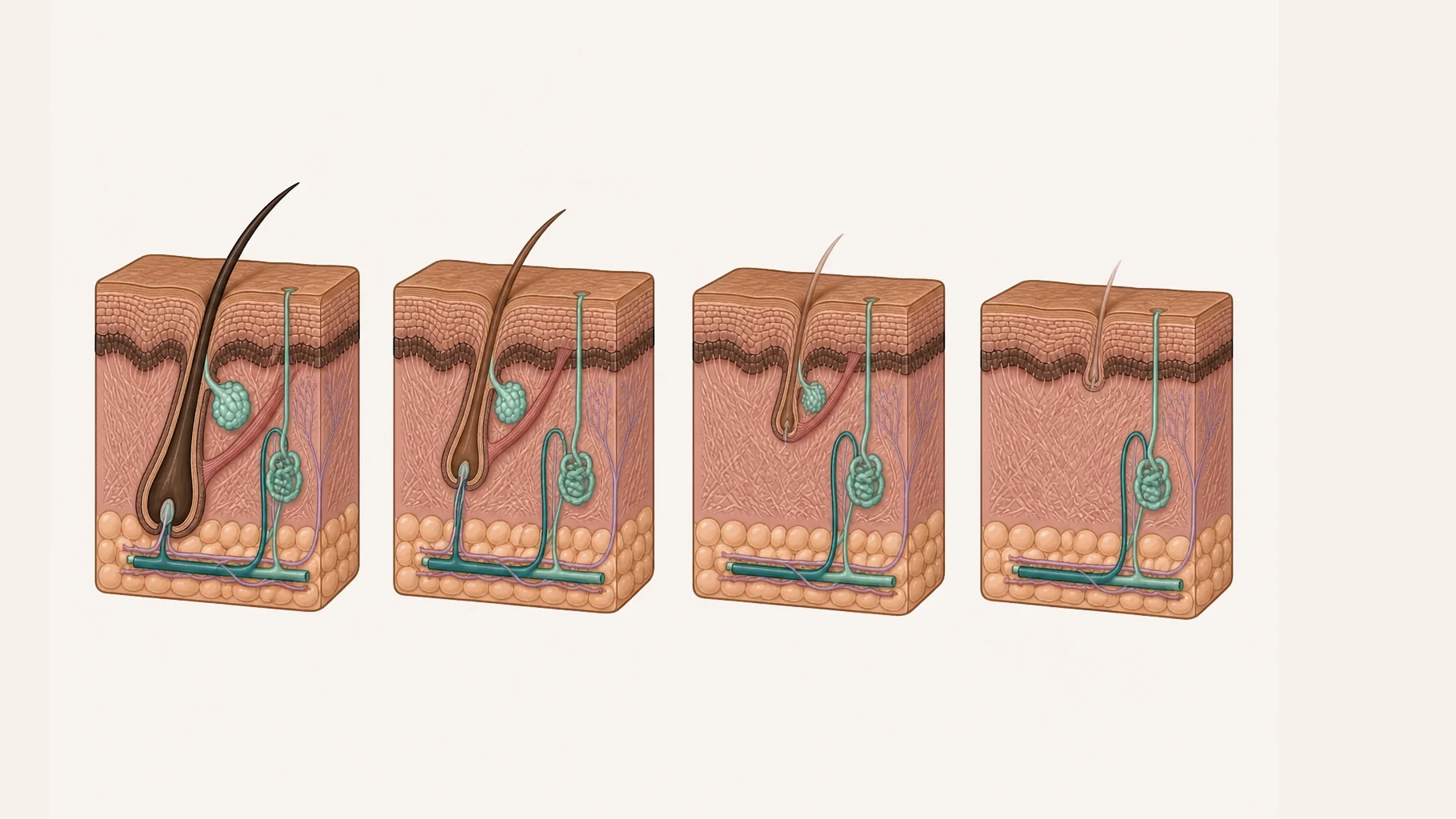
A shrunken follicle can be pushed back. An empty one cannot, which is what sets the window for medical treatment and where surgery starts.
Illustration, not a photograph.
Illness, fever, surgery, childbirth, dieting, new medication, stress. The cause of today’s shedding was usually three months ago.
A pull test, and magnified examination of the scalp: miniaturised hairs, follicular openings, whether scarring is present.
Ferritin, thyroid function, vitamin D and B12 where indicated. Tested, not assumed.
And a review date, because hair is judged at three to six months. Anything judged at three weeks is being judged wrong.
Hair grows about a centimetre a month, and a follicle pushed back into its growing phase takes months to produce visible hair. Nothing genuine works in three weeks, and anything advertised as working in three weeks is selling you the shedding phase of a normal cycle.
There is also an unpleasant truth about pattern hair loss: treatment holds the ground while you continue it. Stopping generally means losing what was gained over the following year. That is said before you start, not after.
If surgery is the answerStandardised, fixed distance. Memory cannot judge hair density over six months; a photograph can.
A treatment used daily for a year outperforms three treatments used enthusiastically for a month each.
Consulting rooms, phototherapy and the surgical list at one address in Secunderabad. The practice was formerly known as BNR Skin & Vitiligo Hospital.
Plot No 13D/B, Wellington Rd, Vikrampuri Colony, Karkhana, Secunderabad, Telangana 500009.
On WhatsApp: one number, answered by the clinic team, who confirm a time and say what to bring.
Sudden diffuse shedding is usually telogen effluvium: a delayed reaction to an illness, fever, surgery, childbirth, crash dieting or severe stress, typically around three months earlier. It is self-limiting, but the trigger is worth identifying and any deficiency worth correcting.
Three to six months for a fair judgement. Hair grows roughly a centimetre a month and a follicle re-entering its growth phase takes time to produce visible hair.
The assessment is the same but the answers differ. Iron deficiency, thyroid disease and hormonal causes are found more often in women, and some treatments used in men are not appropriate for women. Particularly if pregnancy is possible.
Usually a small targeted set: ferritin, thyroid function, and vitamin D or B12 where the history suggests it. Not a broad panel for its own sake.
For pattern hair loss, treatment holds ground while it continues, and stopping generally means losing the gain over the following year. Telogen effluvium and deficiency-related loss usually need treatment only until the cause is corrected.
It depends entirely on the cause. Telogen effluvium and deficiency-related loss recover well. Pattern loss can be slowed and partially reversed. Scarring alopecias destroy the follicle permanently, which is why early diagnosis matters.
The clinical statements on this page follow the guidance and evidence below. They are independent sources. None of them is connected to this clinic, and none of them sells the treatments described here.
Not a treatment plan sold on the spot. Message the clinic and bring your history.