
Phototherapy for psoriasis
The treatment that sits between creams and tablets: effective for widespread disease, without suppressing the whole immune system. Its cost is not money so much as time. Two or three visits a week for a couple of months.
At a glance
- What it is
- 311 nm narrowband ultraviolet B
- Frequency
- 2–3 sessions a week
- Typical course
- 20–36 sessions
- Clearance
- Substantial in most patients
- Remission
- Often months after a completed course
- Best for
- Widespread plaque and guttate disease
Immune suppression, confined to the skin.
Narrowband UVB damps down the inflammatory activity driving psoriasis, but it does so only in the skin the light reaches. That is its central advantage over tablets: no whole-body immune suppression, no liver monitoring, no drug interactions.
It suits widespread disease particularly well, because treating forty plaques with creams is impractical and treating them with a systemic drug is more than many patients need. Guttate psoriasis, dozens of small spots after a throat infection, is close to an ideal indication and often clears completely.
The limitation is logistics. A course means two or three clinic visits a week for two to three months, and courses abandoned halfway are the commonest reason phototherapy is judged not to have worked.
Who is treating you, and what his patients said.

Dr. (Lt Col) Khagendra Varada
- 45 years in dermatology and dermatosurgery
- 25 of them in the Indian Army Medical Corps
- MBBS, Osmania Medical College
- Dip. Practical Dermatology, Cardiff · Dip. Dermatology, AAAM
Reg. No. 10461, Hyderabad State Medical Council
Full background →“I have been going pillar to post to get my son cured of his white spot on his left side of lip and chin. It appeared 8 years back. I was told it’s special type of nerve vitiligo which has no cure. After reporting to him he told us that it is SEGMENTAL VITILIGO and unlikely and difficult to be cleared by medications alone. He suggested for surgical melanocyte transplant… I was amazed after around one month that he started rapidly getting pigmentation. I wholeheartedly suggest please do not waste time like I did.”
“Dr. Varada is an incredibly patient, knowledgeable and wonderful doctor. He sorted out an issue that I had been dealing with for years in one appointment and there’s been no looking back since!”
Immune suppression that stops at the skin.
Narrowband UVB penetrates to a set depth — through the epidermis and into the upper dermis, which is exactly where the inflammatory cells driving a plaque are sitting. It does not reach the rest of you, and that is the entire argument for it.
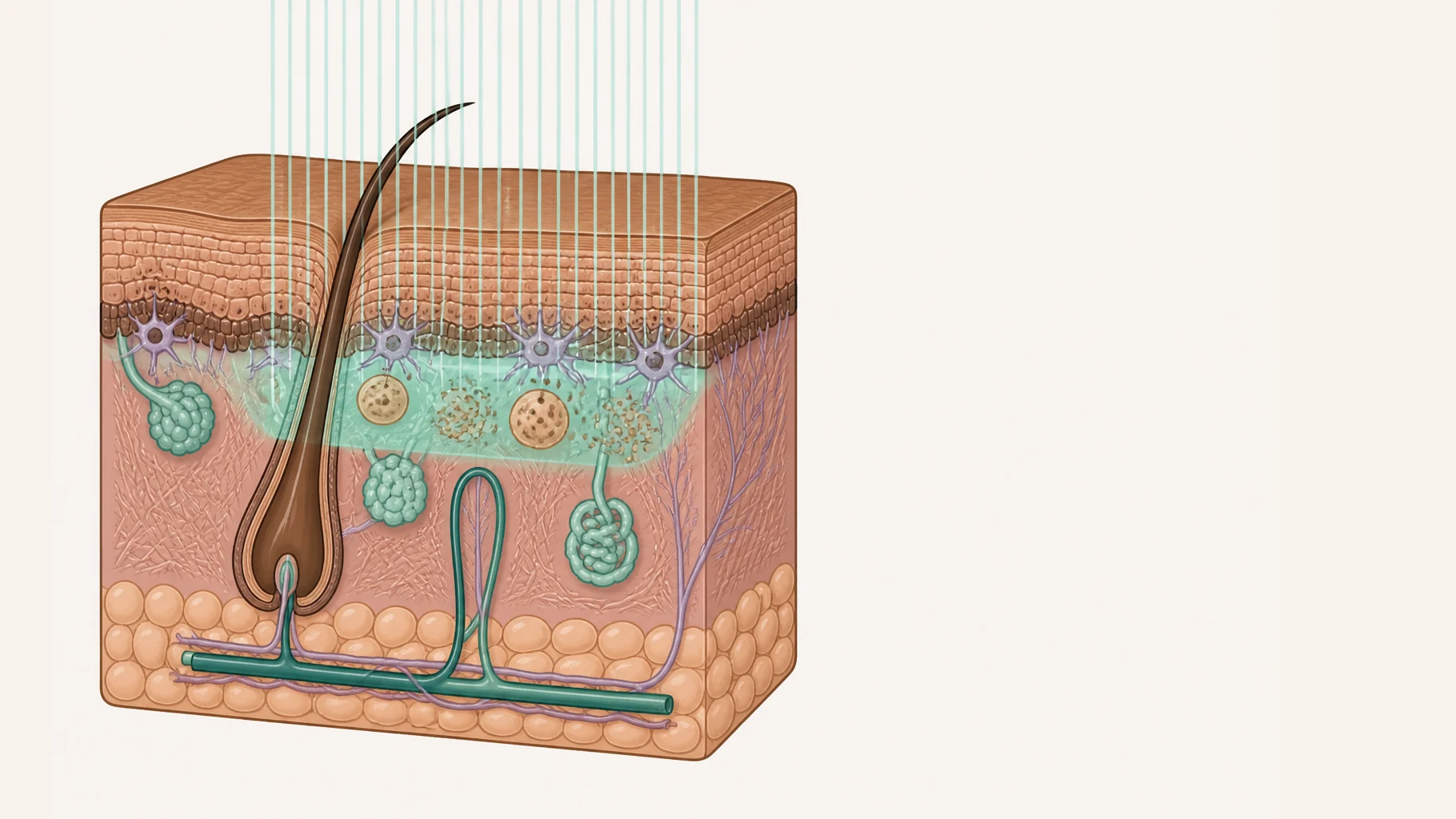
- 1Light enters here
- 2It stops in the upper dermis
- 3The cells it acts on
- 4Nothing deeper is reached
This is why phototherapy carries none of the systemic monitoring that tablets do, and why it remains a first choice for extensive disease in people who can attend regularly.
- Light enters here
- It stops in the upper dermis
- The cells it acts on
- Nothing deeper is reached
Illustration, not a photograph.
What to expect
Dose set to your skin
The starting dose depends on your skin type, and is increased session by session to the point of faint pinkness that fades.
Two to three times a week
Each session lasts seconds to a few minutes. Goggles at every session; men are shielded genitally without exception.
Improvement by week three or four
Plaques flatten before they fade. Residual brown marks after clearance are post-inflammatory and settle over months.
Complete the course, then stop
A finished course frequently gives months of remission. A course stopped at week four usually gives a rapid relapse.
Phototherapy or a systemic drug?
| Phototherapy | Methotrexate / systemics | |
|---|---|---|
| Immune effect | Skin only | Whole body |
| Blood monitoring | None routinely | Regular, ongoing |
| Time cost | 2–3 clinic visits weekly | Tablets at home |
| Works on joints | No | Yes: methotrexate treats arthritis too |
| Pregnancy | Generally acceptable | Methotrexate absolutely contraindicated |
| Remission after stopping | Often months | Usually returns on stopping |
| Best for | Widespread skin-only disease | Joint disease, resistant disease |
If you have psoriatic arthritis, phototherapy will help your skin and do nothing for your joints. That single fact decides the choice for many patients.
The reason courses fail is almost never the light.
Phototherapy has good evidence and a good safety record. What it does not have is convenience, and adherence is the strongest predictor of whether a course works.
So the practical conversation happens before the first session: whether you can realistically attend twice a week for two months, whether the clinic timings fit your work, and whether a systemic drug would actually suit your life better. Choosing the treatment you will finish beats choosing the one that scores best on paper.
Discuss which suits youTimings decide adherence
Sessions are short. It is the travel that people cannot sustain. Worth being honest about before starting.
Cumulative dose is tracked
Lifetime session counts are recorded, as with any ultraviolet treatment.
Phototherapy questions
How many phototherapy sessions will I need for psoriasis?
Most courses run 20 to 36 sessions at two to three a week, so roughly two to three months. Improvement usually begins by week three or four.
How long does remission last afterwards?
Often several months after a completed course, and sometimes longer. It varies considerably. Stopping halfway generally means a rapid relapse.
Is phototherapy safer than methotrexate?
It avoids whole-body immune suppression and routine blood monitoring, which many patients prefer. But it does nothing for joint disease, and it demands far more of your time. Neither is simply safer. They suit different situations.
Can I have phototherapy during pregnancy?
Narrowband UVB is generally considered acceptable in pregnancy and is often the preferred option, because most systemic psoriasis drugs are not. This is decided case by case.
Does it hurt?
No. Sessions are short and feel like warmth. Mild pinkness that fades within a day is the intended endpoint; burning means the dose needs reducing.
Will the brown marks left behind fade?
Yes. Those are post-inflammatory pigmentation, not remaining psoriasis, and they settle over weeks to months once the plaque has cleared.
The clinical statements on this page follow the guidance and evidence below. They are independent sources. None of them is connected to this clinic, and none of them sells the treatments described here.
- PhototherapyDermNet (New Zealand Dermatological Society)
- Psoriasis: assessment and management (CG153)National Institute for Health and Care Excellence (UK)
- Psoriasis resource centreAmerican Academy of Dermatology
- PsoriasisDermNet (New Zealand Dermatological Society)
Related on this site
The first appointment is a diagnosis.
Not a treatment plan sold on the spot. Message the clinic and bring your history.