Where
Plot No 13D/B, Wellington Rd, Vikrampuri Colony, Karkhana, Secunderabad, Telangana 500009.
- Serves Trimulgherry, West Marredpally, Bowenpally, Alwal
- Formerly BNR Skin & Vitiligo Hospital

Some eczema does not respond to correctly used emollients and anti-inflammatories, not because the drugs are wrong but because too little of them is reaching skin that is dry, thickened and scratched. Occlusion changes that. It is an established technique, and this is how it is run here.
A drug applied to dry, thickened skin largely stays on it. Hydrated skin under a covering absorbs many times more of the same drug, because water in the outer layer opens the route through it and the covering stops that water evaporating away. This is why the technique starts with a soak and ends with a seal.
This is not a house invention. Wet wrapping is described by DermNet, by the National Eczema Association and in NICE guidance for atopic eczema, and it has been used in hospital dermatology for decades. What is uncommon is finding it offered in Indian private practice, where it is generally skipped because it takes clinic time that a prescription does not.
What is prepared here is the dressing itself: mixed on the day it is used, at a strength chosen for the site and for how thickened the skin has become.

Dr. (Lt Col) Khagendra Varada
Reg. No. 10461, Hyderabad State Medical Council
Full background →“A year back my father was diagnosed with cellulitis. In consultation with couple of doctors he got treated and was also operated (twice) for the issue, however the progress and recovery noticed was not as per the expectations… he right away with his knowledge and expertise discovered that along with cellulitis he had vasculopathy and eczema in conjunction with oedema… he first treated the wounds in a precise manner and once satisfactory results were seen he focused on his skin allergies and health. Within 5 weeks of visiting Lt Col Sir my father is back normal.”
“Dr Varada is very experienced and friendly, doing great work. I got myself treated for eczema. Thank you very much.”
A preparation spread on dry, thickened skin mostly stays where it was put. The outer layer is a wall of flattened cells packed tight together, and the route between them only opens once those cells have taken up water. Soaking first and then sealing the preparation in is what turns a surface application into something that reaches the tissue underneath.
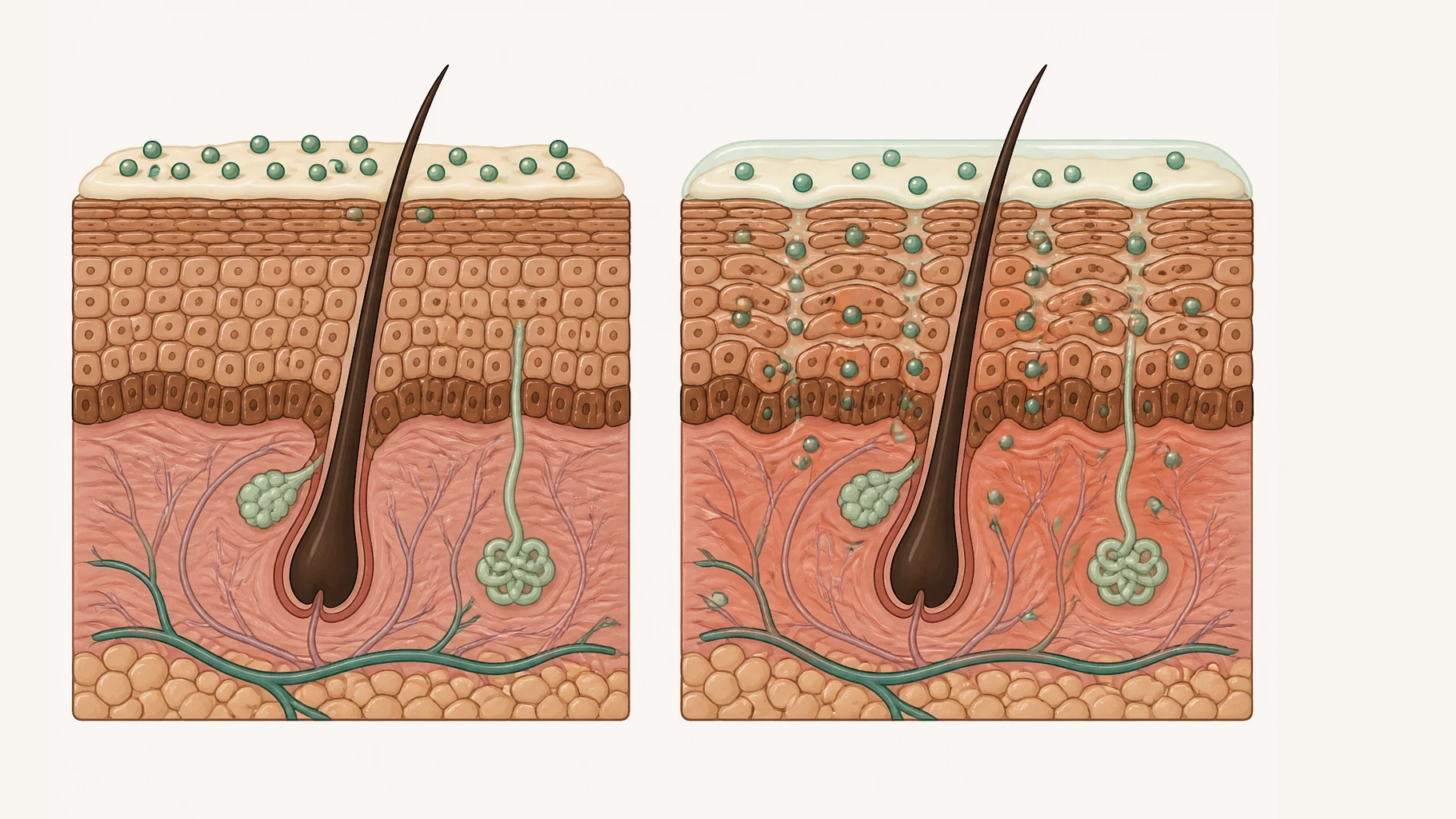
The same preparation and the same quantity, applied two ways. What differs is not the medicine but whether any of it arrives.
Illustration, not a photograph.
The affected area is soaked in normal saline. This is not cleaning. It is hydration: the outer layer takes up water and becomes far more permeable than it was when you walked in.
A poultice is mixed at the clinic that day for that patient. Preparing it fresh is deliberate — the strength is set against the skin as it is now, not as it was at the last visit.
The preparation is applied and covered with fine cellophane. The covering holds the water in and keeps the preparation against the skin, which is what drives absorption through the softened barrier.
The dressing stays on for a set time and the skin is looked at before you leave. The strength for the next sitting is decided from what it did at this one.
None of the four is optional and none of them is quick. The soak is the longest part and the part most often cut short at home, which is the usual reason a course of the same preparation has already failed once before the patient reaches the clinic.
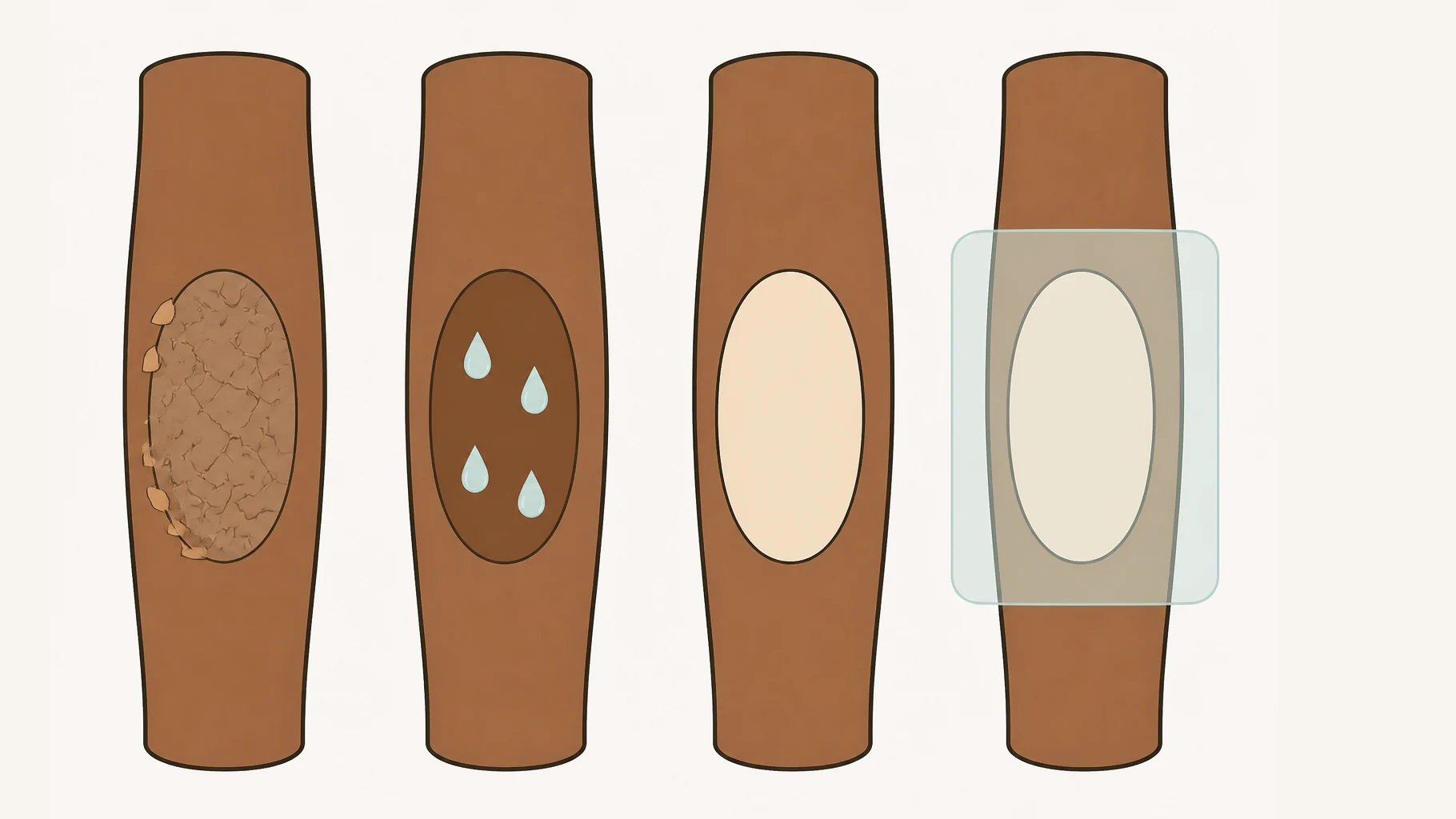
The film comes off at the time given for it. Left on longer it waterlogs the skin, which undoes the sitting it was meant to finish.
Illustration, not a photograph.
| Stage | What happens | Where |
|---|---|---|
| Weeks 1–4 | Dressings at the shorter interval, while the skin is at its most reactive | At the clinic |
| Weeks 5–12 | Remaining sittings, spaced further apart as the skin settles — eight in total | At the clinic |
| Weeks 13–20 | A steroid-free immunomodulator continued daily, with no clinic visits | At home |
| Throughout | Emollient, generously and every day, including on skin that looks clear | At home |
| At the end | Reviewed, and a maintenance plan set for the sites that flare most | At the clinic |
Eight sittings is the usual course, not a fixed rule. How many are needed and over what area is decided at examination, and that is also what the cost depends on — which is why, as with every other treatment on this site, the figure is quoted after examination rather than published here.
Most eczema does not need this. Emollient used generously every day, an anti-inflammatory of the right potency for the site, used for long enough and stepped down properly, controls the large majority of it. Where that has genuinely been done and the skin is still not settling, occlusion is the next step rather than the first.
It suits thickened, intensely itchy, well-defined areas — lower legs, forearms, hands — better than eczema that is faint and spread over the whole body. It is also useful where scratching has become the main driver, because settling the itch breaks the loop that keeps the rest going.
Start with standard eczema treatmentThickened, localised, stubbornly itchy patches that have not responded to correct standard treatment.
Infected skin, widespread faint eczema, or eczema that has simply not been treated properly yet.
Dressings are prepared and applied at one address in Secunderabad. The practice was formerly known as BNR Skin & Vitiligo Hospital.
Plot No 13D/B, Wellington Rd, Vikrampuri Colony, Karkhana, Secunderabad, Telangana 500009.
On WhatsApp: one number, answered by the clinic team, who confirm a time and say what to bring.
Itch usually settles before the rash looks better, and that is the change most patients notice first. How much and how quickly varies between people, and no particular figure is promised.
The dressing is prepared for the individual and what it contains is written down for you. After the clinic sittings, the home phase uses a steroid-free immunomodulator specifically so that long-term use does not rely on steroids.
Because the preparation is mixed on the day, the strength is chosen against the skin as it presents, and the result is looked at before you leave. Wet wrapping done wrong — over infection, or at the wrong strength on thin skin — does harm.
Yes, and children are a substantial part of who it is used for. Strength and duration are set differently for a child, and NICE guidance on eczema in the under-twelves is the reference point.
Most people move to maintenance: emollient daily, and treatment twice a week to the sites that flare most. Eczema is controlled rather than cured, and the plan is written on that basis.
The clinical statements on this page follow the guidance and evidence below. They are independent sources. None of them is connected to this clinic, and none of them sells the treatments described here.
Not a treatment plan sold on the spot. Message the clinic and bring your history.