Where
Plot No 13D/B, Wellington Rd, Vikrampuri Colony, Karkhana, Secunderabad, Telangana 500009.
- Serves Trimulgherry, West Marredpally, Bowenpally, Alwal
- Formerly BNR Skin & Vitiligo Hospital

Most dermatology is prescribed from what a factory already made. Some conditions do better on a preparation mixed for the person in front of you — the right strength, in the right base, for the site being treated. That is done here, and this page explains when it helps and when it does not.
Two patients can be given the identical molecule at the identical strength and get different results, because what the drug is carried in decides how much of it reaches the layer that needs it. An ointment behaves differently from a cream, a cream differently from a lotion, and skin on the shin behaves differently from skin on the eyelid.
A manufactured tube has to work adequately for everybody, so it is formulated for the middle of the range. That is the right decision for a factory and a compromise for a patient at either end of it — thickened, lichenified plaques that need more penetration, or thin facial skin that needs less.
Compounding is simply removing that compromise. The active ingredients are standard, well-understood drugs. What is chosen per patient is the concentration, the base, and the way it is applied.

Dr. (Lt Col) Khagendra Varada
Reg. No. 10461, Hyderabad State Medical Council
Full background →“I was pleasantly surprised when my melasma cleared with four sessions of strong salicylic Acid peels. I believe BNR skin formulates salicylic acid and TCA Peels in house… Therefore they are very effective, only downside is that they sting a lot.”
A preparation is mixed for a named condition, not for a description of a rash. Where the diagnosis is uncertain it is established first, by scraping or examination, before anything is prepared.
Eyelid, face, trunk, palm and sole absorb at very different rates. The same drug is prepared at different strengths for different sites on the same patient.
Weeping skin, dry cracked skin and thickened plaques each need a different base. A preparation that suits week one is often the wrong one by week six.
The formulation is changed as the skin changes. That is the point of preparing it here rather than buying a fixed product — it can be altered at the next visit instead of at the next product launch.
A prescription is not only a drug and a strength. It is also what that drug is carried in, and the carrier is decided by the skin it has to cross. Thick, hardened skin needs a greasy base that stays put long enough to soften it. Hair needs something thin enough to run down to the scalp rather than sit on the hair. Thin skin in a fold takes up a drug readily, so it needs less of everything.
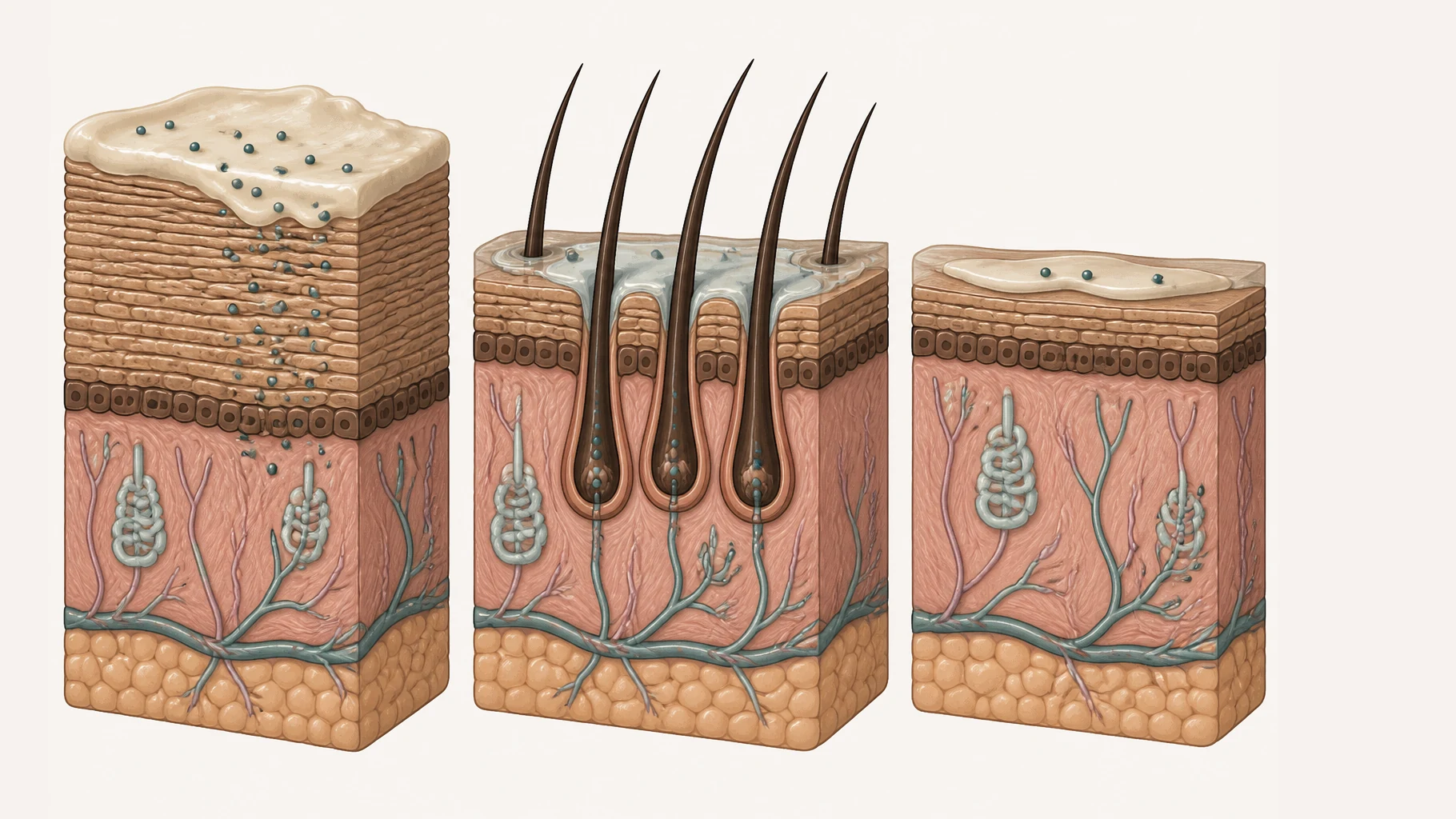
Which is why the same condition on two people — or on two parts of the same person — does not sensibly get the same tube.
Illustration, not a photograph.
| Preparation | Used for | Why it is compounded |
|---|---|---|
| Occlusive poultice dressing | Eczema that has not settled on standard treatment | Applied under occlusion at the clinic; see the protocol |
| TV lotion | Pityriasis versicolor — the pale patches of the hot months | Formulated to reach the hair follicle, where the yeast sits |
| Site-specific anti-inflammatory bases | Face, eyelids, flexures, palms and soles | One strength per site rather than one strength per patient |
| Keratolytic preparations | Thickened plaques, palms and soles | Strength titrated to the thickness actually present |
| Depigmenting and camouflage preparations | Selected pigment problems | Concentration adjusted to skin tone and response |
Every active ingredient used is a standard pharmaceutical. What is decided here is the concentration and the base, not the chemistry.
It does not turn an incurable condition into a curable one. Eczema, psoriasis and vitiligo behave the same way whoever mixes the ointment; a better-matched preparation improves control and comfort, and that is the whole of the claim.
It does not replace a diagnosis, and it is not a reason to start treatment before one. Nor does it substitute for the systemic treatment some disease genuinely needs — a preparation applied to the surface cannot do the work of a tablet where a tablet is what is indicated.
How treatment costs are quotedThe ingredients are ordinary pharmaceuticals. There is no proprietary molecule and none is claimed.
As everywhere else on this site: response varies, and nothing here is guaranteed.
Preparations are mixed at the clinic and used there or dispensed the same day. The practice was formerly known as BNR Skin & Vitiligo Hospital.
Plot No 13D/B, Wellington Rd, Vikrampuri Colony, Karkhana, Secunderabad, Telangana 500009.
On WhatsApp: one number, answered by the clinic team, who confirm a time and say what to bring.
Not inherently. It is better matched. A branded product that already suits the site and stage is the simpler choice, and is what is prescribed most of the time. Compounding is for the cases where nothing on the shelf is the right strength in the right base.
No. They are standard pharmaceuticals, the same molecules used in manufactured products. What is decided per patient is the concentration and the base.
Yes. What has been mixed and at what strength is written down and given to you. A preparation whose contents you are not told is one to be wary of, and that applies here as much as anywhere.
It is quoted after examination, like every other treatment here. The consultation fee is fixed and is published on the contact page; treatment figures depend on what is actually being treated and over what area.
The clinical statements on this page follow the guidance and evidence below. They are independent sources. None of them is connected to this clinic, and none of them sells the treatments described here.
Not a treatment plan sold on the spot. Message the clinic and bring your history.