Karkhana, Secunderabad Mon–Sat, 11:30 am – 5:00 pm  ·  formerly BNR Skin & Vitiligo Hospital ★ 5.0 on Practo · 10,000+ patients treated
HomeVitiligoTreatment systems compared
Vitiligo · Choosing

Vitiligo treatment systems, compared on evidence

Most people with vitiligo in India try more than one system of treatment, and usually a traditional one first. That is a reasonable thing to do with a condition this old. This page is not an argument against anyone. It sets out what each system actually gives you, how it works when it works, what the published evidence supports, and the questions to ask any practitioner before you pay.

At a glance

Shared root
Psoralen plants and sunlight: Ayurveda, Unani and PUVA
Dermatology
NB-UVB, excimer, JAK inhibitors, surgery; trial evidence
Ayurveda
Bakuchi, diet, panchakarma; small uncontrolled studies
Unani
Psoralea and Ammi majus formulations; small studies
Homeopathy
No plausible mechanism; no controlled evidence
Every system
No cure; stability still decides surgery
Common ground

The oldest treatment and the first modern one are the same molecule.

Around four thousand years ago, in Egypt and in India, people with white patches were given the crushed seeds of a plant and told to sit in the sun. In India the plant was bakuchi, Psoralea corylifolia; in Egypt it was Ammi majus. Both contain psoralens, molecules that make skin intensely sensitive to ultraviolet light. Ayurveda and Unani still use them.

In the 1940s a Cairo dermatologist purified the active compound, methoxsalen, and dosed it with measured light. That is PUVA, the first modern treatment for vitiligo, and it is the traditional remedy with a meter attached. Dermatology did not reject the old treatment; it measured it, and then found safer light.

So the honest comparison between systems is not ‘works’ against ‘does not work’. It is about which claims have been measured, how the dose is controlled, what else is in the preparation, and how long you spend finding out.

Before you decide

Who is treating you, and what his patients said.

Dr. (Lt Col) Khagendra Varada, dermatologist and dermatosurgeon

Dr. (Lt Col) Khagendra Varada

  • 45 years in dermatology and dermatosurgery
  • 25 of them in the Indian Army Medical Corps
  • MBBS, Osmania Medical College
  • Dip. Practical Dermatology, Cardiff · Dip. Dermatology, AAAM

Reg. No. 10461, Hyderabad State Medical Council

Full background →

“I have been going pillar to post to get my son cured of his white spot on his left side of lip and chin. It appeared 8 years back. I was told it’s special type of nerve vitiligo which has no cure. After reporting to him he told us that it is SEGMENTAL VITILIGO and unlikely and difficult to be cleared by medications alone. He suggested for surgical melanocyte transplant… I was amazed after around one month that he started rapidly getting pigmentation. I wholeheartedly suggest please do not waste time like I did.”

★★★★★Gunaganti Madaru · Google

“Dr. Varada is an incredibly patient, knowledgeable and wonderful doctor. He sorted out an issue that I had been dealing with for years in one appointment and there’s been no looking back since!”

★★★★★Apurv Vedantam Isaac · Google
Read all 70 stories →
What any treatment has to do

Stop the attack, then bring the cells back.

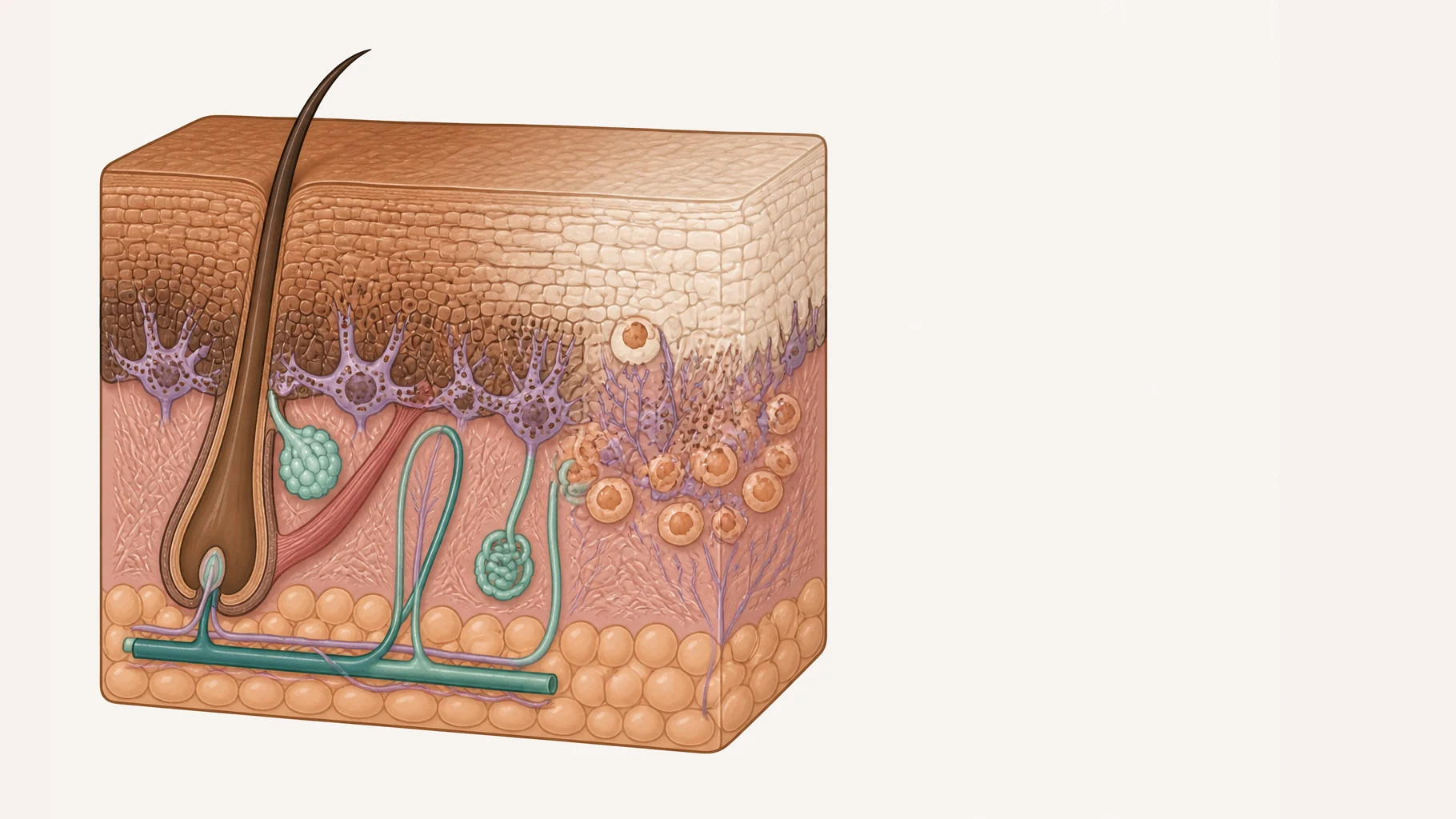
Vitiligo is the loss of pigment cells to an immune attack. Whatever system a treatment belongs to, it can only do two useful things: quieten that attack, and recruit surviving pigment cells from the hair follicles back into the skin. A claim that cannot be described in those terms is not describing a mechanism.

A magnified view of the base of the epidermis. On the left, star-shaped pigment cells are intact and passing dark granules into the surrounding skin cells, and the skin above is warm brown. Toward the right, immune cells have gathered and closed in: one pigment cell is shrunken, another is breaking apart, and the skin above has lost its colour and turned pale.
  1. 1Pigment cells at work
  2. 2Colour lost above
  3. 3Immune cells closing in

Judge every system against this picture. Psoralen plants and light recruit cells; steroids, calcineurin and JAK inhibitors quieten the attack; surgery moves cells from elsewhere. Anything that does neither is asking you to wait, and waiting is the one cost every system shares.

  1. Pigment cells at work
  2. Colour lost above
  3. Immune cells closing in

Illustration, not a photograph.

Side by side

Four systems, one condition

Each row is what the published literature supports, not what any particular practitioner claims. Every system has good and poor practitioners; the row describes the system.

DermatologyAyurvedaUnaniHomeopathy
What is givenTopical steroids, tacrolimus, JAK inhibitors, narrowband UVB, excimer, graftingBakuchi (psoralen) paste or oil with sun; oral herbal formulations; diet rules; panchakarmaPsoralea and Ammi majus formulations, oral and topical, with sun; diet rulesHighly diluted remedies chosen by symptom picture
Mechanism shownImmune suppression in the patch; follicular pigment cells recruited by light; cells moved by surgeryPsoralen photosensitisation: the PUVA mechanism, unmeteredPsoralen photosensitisation: the PUVA mechanism, unmeteredNone demonstrated at the dilutions used
EvidenceRandomised trials, national guidelines, the IADVL surgical consensusSmall uncontrolled series; psoralen chemistry well studiedSmall uncontrolled series and institutional trialsCase series and open observational studies; no controlled trial showing an effect
How improvement is reportedMeasured extent (VASI) and photographs at fixed intervalsUsually as a share of patients ‘improved’, without measurementUsually as a share of patients ‘improved’, without measurementCase reports
Time to a verdictThree to six months for light and creams; three months for a graftMonths to years; no defined stopping pointMonths to years; no defined stopping pointOpen-ended
Cost patternPer session, per procedure; consultation fee fixedOften monthly courses of formulations; sometimes packagesOften monthly courses of formulationsMonthly
Main riskSteroid thinning if misused; monitoring burden with oral JAK inhibitorsPhototoxic burns and blisters; liver injury reported with oral Psoralea; undeclared steroids in some dispensed preparationsPhototoxic burns; undeclared steroids in some dispensed preparationsDelay while active disease spreads

Undeclared steroids are not a feature of any system; they are an adulteration found in surveys of preparations dispensed by some practitioners, across systems, and never in this clinic’s own formulations, which are labelled.

What ‘improved’ means

The same word, three different measurements

Dermatology

Measured and photographed

Extent is scored, the patch is photographed at fixed distance and light at every review, and a treatment that has not moved a patch by the agreed review is changed.

  • A number you can compare
  • A date you can hold to
  • A defined point at which it stops
Ayurveda and Unani

Reported, often as a percentage

Published series tend to report the share of patients who improved, judged by eye. Some of that improvement is real, some is segmental vitiligo burning out on its own, and without measurement the two cannot be told apart.

  • Ask how it is measured
  • Ask when it would be called a failure
Homeopathy

Case reports

The literature is case series. A dilution beyond the point where any molecule of the original substance remains has no proposed way to affect an immune attack, and none has been shown.

  • The main cost is time
Where they meet

Bakuchi and sun is PUVA without a meter.

The single most useful thing to understand about traditional vitiligo treatment in India is that its most active ingredient is a real drug. Psoralen applied to skin and followed by sunlight repigments vitiligo by the same mechanism as PUVA, and it burns by the same mechanism too. The published reports of blistering, including in children, and of liver injury with oral Psoralea, are the predictable consequences of a photosensitiser used without a dose.

Dermatology’s answer was first to weigh the psoralen and meter the light, and then to move to narrowband UVB, which needs no sensitiser and carries less long-term risk. If you are using bakuchi now, the useful conversation is not whether to feel foolish; it is how to get the same mechanism with a dose.

Diet is the other shared claim, and here the evidence is clear in the other direction: no diet has been shown to repigment vitiligo or to stop it spreading, in any system. The diet page sets out what has been studied.

In any system

Seven questions to ask before you pay anyone, including us.

  • What is in the preparation, by ingredient name?
  • Is it licensed, and does the pack carry a licence number?
  • How will improvement be measured, and will I get the photographs?
  • What stops the spread while the colour is coming back?
  • When will you tell me it is not working, and what happens then?
  • Is the price per month, or a package I cannot leave?
  • Does anything in this contain a steroid? Ask it plainly, and keep the answer.
The shared cost

Time is the price every system charges.

Vitiligo has a window. Active disease that is quietened early keeps more of its follicular reservoir; stable disease can be grafted; and a patch whose hairs have turned white while a course ran on has lost the option that light and creams depend on. None of that is unique to one system. It is the argument for measuring, whichever system you are in.

The protection is cheap: photograph every patch monthly, at the same distance and in the same light, from the first day of any treatment. If the border has moved outward, the treatment is not controlling the disease, whatever it is called.

How stability is judged

Segmental vitiligo burns out anyway

It stops on its own within a year or two. Whatever you were taking at the time will get the credit. Only measurement tells the difference.

Combining systems needs telling

Psoralen from a herbal preparation plus a phototherapy session is a double dose of the same drug. Tell both practitioners what the other has given you.

Questions patients actually ask

Choosing a system

Is Ayurvedic treatment effective for vitiligo?

Its most active ingredient, bakuchi, contains psoralen and genuinely repigments vitiligo with sunlight, by the same mechanism as PUVA. The published evidence is small uncontrolled series, the dose is not controlled, and burns and liver injury with oral use are documented. No Ayurvedic treatment has been shown to cure vitiligo or to stop it spreading.

Does Unani medicine cure vitiligo?

No system cures vitiligo. Unani formulations for it are built on Psoralea and Ammi majus, the same photosensitising plants behind PUVA, used with sunlight. They can repigment; they cannot switch off the immune attack, and the evidence for them is institutional series rather than controlled trials.

Does homeopathy work for vitiligo?

There is no controlled trial showing an effect, and no proposed mechanism by which a remedy diluted past the last molecule could act on an immune attack. The literature is case reports. Its cost is mainly the months of active disease that pass while it is tried.

Can I combine Ayurveda or Unani with dermatology treatment?

Only with both practitioners knowing. A psoralen preparation applied at home plus a phototherapy session is two doses of the same drug and a burn waiting to happen. Bring every preparation you use to the consultation, including the ones that seem harmless.

Why do some clinics quote a percentage of patients cured?

Because a figure sells. A registered dermatologist cannot quote one, because no outcome in vitiligo can be promised before examination, and because the word cure does not apply. Treat any fixed figure, from any system, as marketing rather than information.

Which system is right for me?

The one that will measure you. Whichever you choose, ask how improvement will be judged, photograph your patches monthly, and set a date at which you will reassess. If you want the psoralen mechanism, dermatology can give it to you with a meter; if you want the immune attack stopped, only dermatology has the drugs that do it.

References

The clinical statements on this page follow the guidance and evidence below. They are independent sources. None of them is connected to this clinic, and none of them sells the treatments described here.

  1. A review of Psoralea corylifolia L.: a valuable plant with profound biological significancePubMed Central (2025)
  2. Acute liver failure associated with Fructus Psoraleae: a case report and literature reviewPubMed Central (2019)
  3. Severe phototoxic reaction to Psoralea corylifolia seeds in a child with vitiligoPubMed (2024)
  4. Misuse of corticosteroids in some of the drugs dispensed as preparations from alternative systems of medicine in IndiaPubMed (2001)
  5. Vitiligo: diagnosis and treatmentAmerican Academy of Dermatology
  6. Vitiligo: treatmentNHS
  7. VitiligoDermNet (New Zealand Dermatological Society)
  8. Consensus-based guidelines for surgical management of vitiligo, Vitiligo Task Force, IADVL Academy 2024–2025Indian Journal of Dermatology, Venereology and Leprology

The first appointment is a diagnosis.

Not a treatment plan sold on the spot. Message the clinic and bring your history.

Book on WhatsApp Call